Some Stars Grow a Disc Like Saturn's Rings, Then Lose It
Some stars grow a disc like Saturn's rings, then lose it.
Based on the abstractOpen access (CC BY 4.0 in the Crossref record)
Can a star really grow a disc and lose it again?
An all-sky catalogue of classical Be stars caught moving between quiet and active phases, built from Gaia positions and repeated mid-infrared brightness measurements by WISE and NEOWISE-R; the starting list was 4.2 million candidate stars.
The final catalogue holds 3,300 of these stars, 2,743 of them newly identified. The study traces the disc forming and fading through linked changes in infrared brightness and colour.
The median outburst phase lasted 459 days and the median decay phase 478 days (just over 15 months each).
TESS brightness data for 3,017 of the stars found 63 eclipsing pairs (33 Algol-type, 17 Beta Lyrae-type, 13 W Ursae Majoris-type).
In LAMOST spectra, two stars showed candidate velocity shifts over 20 km/s; the way their spectral lines behaved suggests such shifts in active stars may be influenced by outburst-related changes in the lines, rather than being an unambiguous sign of a partner.
Read from the abstract only. The discs are traced in infrared light, not photographed. The wobble point rests on two stars and is a suggestion, not a finding. Our remarks, not the study's: Saturn (these discs are not ice rings), the baby and the blink (the abstract calls these timescales long, for a disc; a star lives far longer), "not a photo" (our plain reading of "traces"), and "the usual suspect" for a partner.
Short link: thelast24hoursscience.com/s/R0OIonYw4hc
An all-sky catalogue of Be transition stars from WISE and Gaia
Read the study DOI: 10.1093/mnras/stag2077 · CC BY 4.0 in the Crossref recordThis is general information, not medical or professional advice.
Some stars grow a disc like Saturn's rings, then lose it. Typically, just over fifteen months each way.
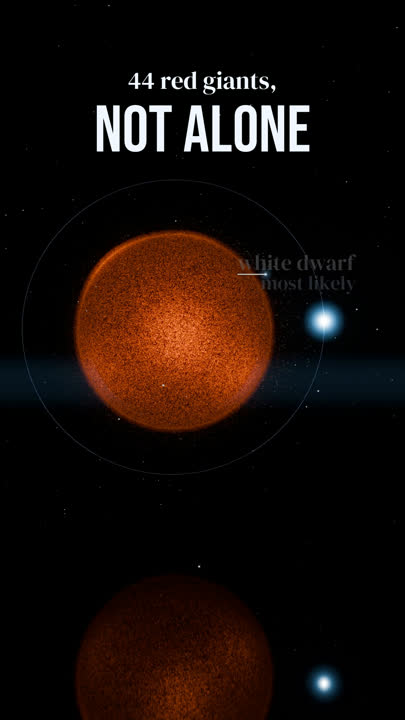
That's about how long a baby takes to start walking, and for a star it's a blink. An outburst builds the disc, then it decays and the star goes quiet. A study out twenty-two hours ago searched the whole sky for them. From millions of stars, it pulled out thousands caught changing, most newly identified. That's a trace in their infrared light, not a photo of any disc. Some have a partner star: dozens were caught in pairs that eclipse each other. So when two stars seemed to wobble, the usual suspect would be a hidden partner tugging on them.
But the outburst itself may be reshaping the star's light, so a wobble isn't a sure sign of a partner. Just two stars, so it's only a hint.
These discs come and go, and even the wobble may not be what it seems.
New science from the last twenty-four hours, every day.
Spotted a mistake? Tell us and we'll fix it. Every video's sources
iPhone app · coming soonToday's discovery, on your Home ScreenFree. Pro is optional.Five Shorts a day, a sleep video every other night and a deep dive each week. Every one names its source.