The Last
24 Hours

ArchaeologyShort1:00

A Knee Surgery Robot Found This Neanderthal Was 9° Bow-Legged

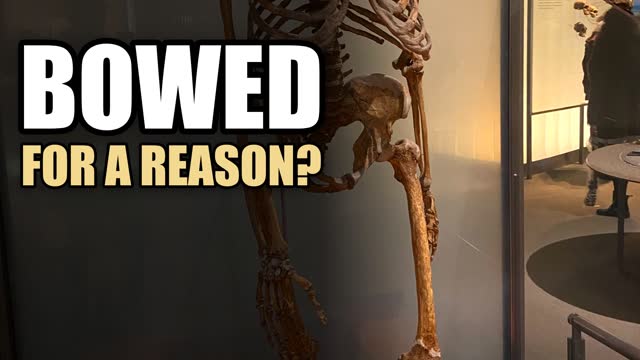
A knee-surgery robot measured a life-size printed copy of the Spy II Neanderthal's leg bones: 9 degrees of bow (varus), against about 0 for a typical modern leg.

Peer-reviewed journalOpen access (CC BY 4.0)

This video was corrected on 26 Oct 2026: see corrections.

Watch on YouTube

The question

What does a knee-surgery robot see in a Neanderthal's legs?

Key findings

  • His knee was bowed by 9 degrees (modern typical: about 0), a shape doctors may call pre-arthritic, yet his knee showed no joint disease
  • The same shape is seen in modern athletes who trained hard while growing, and forcing it straight made the joint tight inside. One skeleton, a printed copy, borrowed soft tissue: a clue, not proof

How they know

Proof-of-concept: a robotic knee-replacement system (CORI) measured an original-size 3D-printed model of the Spy II Neanderthal femur and tibia; soft tissue approximated from a modern patient.

The catch

One Neanderthal, a printed copy (one tibia mirrored), and soft tissue borrowed from a modern patient: the authors say it cannot be generalised and functional inferences are speculative.

Sources and credits

Short link: thelast24hoursscience.com/s/2FXfjarq4R8

The study

Robotic-assisted knee arthroplasty methods provide insight into Homo neanderthalensis gait and the evolutionary origins of modern human knee variation

Pott et al. · Scientific Reports · 2026 · first public 25 Oct 2026

Read the study DOI: 10.1038/s41598-026-77544-z · CC BY 4.0

Made by

  • Pictures: our own illustrations and our own 3D render.
  • Narration: a synthetic voice.

This is general information, not medical or professional advice.

Read what the video says

A knee surgery robot just measured a Neanderthal, and he was bow-legged.

A study out twenty hours ago printed a life-size copy of one Neanderthal's leg bones, and ran the robot used for real knee replacements.

His knee was bowed by nine degrees. A typical modern leg is close to straight.

Back when Neanderthals were first found, a famous scientist blamed their bowed legs on rickets, or too much horse riding.

Today, doctors might see that bend as a warning sign for arthritis. Yet his knee showed no sign of joint disease.

It's one skeleton and a plastic copy, with soft tissue borrowed from a modern patient. A clue, not proof.

But here's the twist.

The same knee shape shows up today in athletes who did heavy, pounding sport while growing.

Forced straight, the way surgeons often set knees, his joint came out too tight on the inside. Following his own shape balanced it.

So a bowed knee may be a body type, not a fault.

Is your knee straight, or a little bit Neanderthal?

Spotted a mistake? Tell us and we'll fix it. Every video's sources

iPhone app · coming soonToday's discovery, on your Home ScreenFree. Pro is optional.

More archaeology

A new study, explained, every few hours

Five Shorts a day, a sleep video every other night and a deep dive each week. Every one names its source.

Subscribe on YouTube